
An Alternative to Alternative Healing

I’m one of those Dungeon Masters who began playing D&D in the good old days of AD&D2nd Edition. Those of you who remember those youthful days will not be surprised when I say that … it kills me a little inside when my 5th edition players wake up after a long rest… fresh as a daisy sprite and at full Hit Points!
I have to work real hard to suppress the “old man” who wants to gripe,
“Back in my day you could only heal 1 hit point per day of rest, or maybe 3 for cushy “bed rest,” gosh darn it!”
If you want to take a trip down memory lane, I highly recommencement this record of “Healing Through the Ages” on Delta’s D&D Hotspot.
Like a lot of DM’s I’ve tinkered with the ideas of “fixing” hit points and player damage. But I could never come up with a better set of home rules because the design isn’t broke and doesn’t need “fixing.”
Matt Colville, in his Running the Game #68, does a much beater job of explaining it than I ever could, when he says,
“Hit points work because that’s how we wished we worked…” they are “…a measure of your heroism…”
But… it still gals me that players will wake up the next day, after a punishing fight, with no ill affects whatsoever. It just feels so “wrong” that players should incur no lasting injuries as a result of taking high amounts of “damage” in “deadly encounters.”

One option would be to implement some of the alternative healing and resting rules that are on p.266-267 of the 5e Dungeon Masters Guide. But if those rules worked better than the rules in the Players Handbook I think they would not be alternate rules in the DMG. Also, allowing players to recover full HP in the morning fits very nicely with he whole “hit points are …a measure of your heroism…“ ideal.
So what we need is some way to give players an “injury” without messing with their hit points. By “injuriy,” I mean a home brew Injury condition. But unlike “wound levels” discussed by Colville, in the above linked video, I would only apply an “injury” when a player is reduced to zero (0) HP or fails a death saving throw.
Before you get any grand visions of rolling on multiple tables that cross-reference damage type/severity with body parts (believe me, that also my was my first instinct), remember that simplicity is a virtue and we already have an under used resource in the 5eD&D rule set that already looks a lot like injuries, … exhaustion.
THE “SIMPLE” INJURY CONDITION
Whenever a player character is reduced to zero (0) or fewer HP, and whenever they fail a death saving throw, the character incurs a single level of the exhaustion condition as an injury.
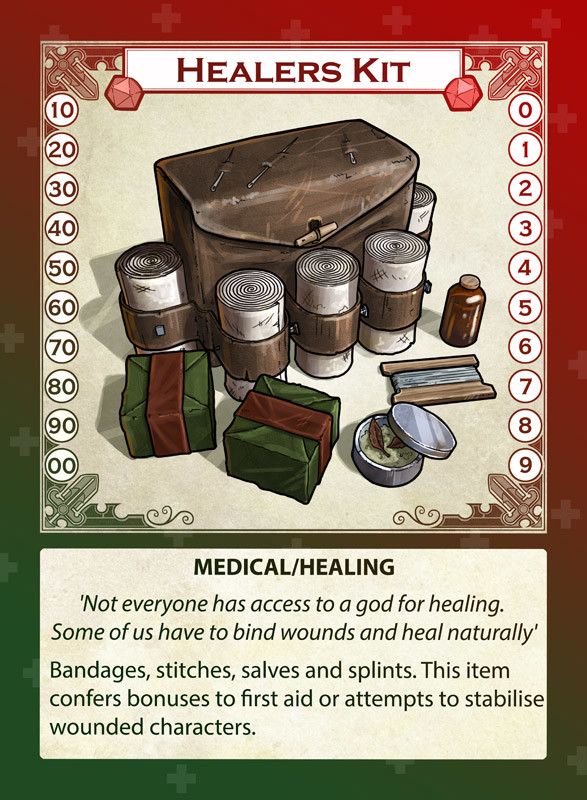
Like normal levels of exhaustion these levels of injury increase the characters over all exhaustion level. However, unlike normal levels of exhaustion, these “injury levels” can not be removed by simply completing a long rest. Levels of injury can only be removed by casting the Greater Restoration spell or with a successful DC20 medicine skill check. The medicine check can only be attempted once after the injured character has finished a long rest in which specific treatment for the injury was applied.
A successful healing check (or casting of the Greater Restoration spell) only removes a single level of the injury condition. Failed checks have no effect other than the injury condition persists and another check can not be made until after the injured character has completed another long rest.
For reference here’s a link to the Conditions & Exhaustion rules in the Players Handbook.
I think this simple home brew option could have lots of fun consequences. Much like real injuries, full recovery from the injury condition can be highly variable in both its severity and the needed recovery time. As I indicated, and depending on how you play, the exhaustion condition could be a rather under used aspect of the 5e rule set. This home brew Injury condition makes exhaustion something that the players have to really think about. Adding this rule to your could potentially kill PCs who are already suffering levels of exhaustion, or who drop below zero hit pints multiple times during an adventure or encounter. The threat of lasting consequences due to an injury adds a real danger to a battles or encounters that might not otherwise be deadly enough to kill characters outright.

 Jötunhiemr