
While it can be tempting (and freeing!) to dispense with restrictions of the use of magic and spell casting in D&D and similar RPGs. It definable makes bookkeeping much easier for players and DMs alike, but at what cost?
When we remove the need for material spell components pay a cost for the in-game convenience that we are seeking to acquire. That cost is the value of magic as something difficult and costly. In stories and literature what makes magic so compelling is not just the affects that a spell creates, but also the items needed and the times and places and actions required to enact the magical affect. Requirements are the stuff of magic.
What follows are individual rules or practices to help immerse a 5e D&D game with the idea that magic has costs. These home brews are intended to make as little change as possible to the rules as write in the 5e players handbook.

#1 Being strict with spell components.
Lets start by quoting what the PHB has to say on the matter.
Components
5e Players Handbook p. 203
A spell’s components are the physical requirements you must meet in order to cast it. Each spell’s description indicates whether it requires verbal (V), somatic (S), or material (M) components. If you can’t provide one or more of a spell’s components, you are unable to cast the spell.
Verbal (V)
Most spells require the chanting of mystic words. The words themselves aren’t the source of the spell’s power; rather, the particular combination of sounds, with spe-cific pitch and resonance, sets the threads of magic in motion. Thus, a character who is gagged or in an area of silence, such as one created by the silence spell, can’t cast a spell with a verbal component.
Somatic (S)
Spellcasting gestures might include a forceful gesticula-tion or an intricate set of gestures. If a spell requires a somatic component, the caster must have free use of at least one hand to perform these gestures.
Material (M)
Casting some spells requires particular objects, specified in parentheses in the component entry. A character can use a component pouch or a spellcasting focus (found in chapter 5) in place of the components specified for a spell. But if a cost is indicated for a component, a char-acter must have that specific component before he or she can cast the spell.
If a spell states that a material component is consumed by the spell, the caster must provide this component for each casting of the spell.
A spellcaster must have a hand free to access these components—or to hold a spellcasting focus—but it can be the same hand that he or she uses to perform somatic components.
Lets be honest. The purpose of all of these spell components is that they are things that can be taken away from the players. It’s right there, implied in the text.
Its classic stuff! Gandalf breaking Sauron’s staff or the Harkonnen thugs gagging Lady Jessica so she can’t speak. Its just that players hate it when it happens to them. But they should LOVE it, because it makes for great story, if done sparingly.
Whats interesting is how component pouch or a spellcasting focus are given in bold. Because who wants to track blades of grass and bits of cotton or metal wire, righht?

#1.1 Keep track of all your spell components.
This is easy. Its one page of paper with five coulombs. Spell Name; Verbal (Y/N); Somatic (Y/N); Material Component (MCs) & value; Number of MC’s on Hand
Here is an Example:
Once you’ve entered in a spell on this table the only thing you have to change is the last column, Number of MC’s on hand.
But now we run into the fact that keeping track of the mundane spell component (like blades of grass for magic missile) can feal pointless and annoying. This is exactly why the options for a component pouch or a spell casting focus exist.
#1.2 If you want to use a “component pouch” you need to spend downtime keeping it updated.
My preference is for players to keep track of actual components as described above. However if this is intolerable to the players or the DM then spellcasters who use a “comment pouch” need to spend time constantly updating and refreshing the components in their pouch.
This can be done as a downtime activity and can be customized to reflect the relative amount of spell casting done during an adventure. GM’s and players can determine exactly how much time this requires. If the character has cast a large number of spells they may not be able to use as much of their discretionary downtime as other characters. The DM is also free to rule that some components may not be acceptable in all places (blades of grass on the plane of fire for example).
#1.3 If you want to use a “spellcasting focus” you must bond with it.
For purposes of the following house rule “spellcasting focus” can refer to an arcane focus, a druid’s focus or a holly symbol. All three are treated the same.
House Rule: Before using it to cast spells, a spell caster must “bond” with their spellcasting focus. Bonding works similar to attunement except it does not use an attunement slot and the spell caster must bond with a focus up to the level for which they intend to use it. Bonding requires a Ritual Bonding Time and a Bonding Cost
Ritual Bonding Time: This is the time needed to bond with a spell casting focus. The step time is the time needed to increase ones bond with a focus in order to cast spells at a higher level. The total time is the time needed to bond with a newly acquired focus up to the desired casting level.
Bonding: This is gold piece value (gp) of the material components need for the bonding. If the item itself is particulary valuable or expensive then it can account for this cost itself. If the focus is humble origin and not very expensive then the balance of the bonding cost must be spent on items such as incense, gem dust, holly water, arcane oils, or blood. The step cost is the cost to upgrade a focus from one level to the next and the total cost is the cost needed to bond with a newly acquired focus up to the desired casting level. The following table are my sugested costs. They could be higher or lower or the DM could be more free-form in what it takes to craft/bond with a new focus. The pont is to not make it easy. Players need to somehow pay a cost for the convineince of using a spell casting focus.
| Focus Bonding Level | Ritual Bonding Time (hours) Step Time , Total Time | Bonding Cost Step Cost, Total Cost |
| 1 | 1 hour / 1 hour | 25 gp / 25 gp |
| 2 | 1 hour / 2 hours | 50 gp / 75 gp |
| 3 | 1 hour / 3 hours | 75 gp / 150 gp |
| 4 | 1 hour / 4 hours | 150 gp / 300 gp |
| 5 | 1 hour / 5 hours | 225 gp / 525 gp |
| 6 | 1 hour / 6 hours | 325 gp / 850 gp |
| 7 | 1 hour / 7 hours | 450 gp / 1,300 gp |
| 8 | 1 hour / 8 hours | 700 gp / 2,000 gp |
| 9 | 1 hour / 9 hours | 1,000 gp / 3,000 gp |
EXAMPLE: Your Wizards staff is broken! Time is short and the Orcs will be arriving in 3-4 hours. You can easy obtain a new staff but you lack the necessary arcane components for the bonding ritual. But in your adventures you obtained an amulet with a ruby easily worth 150gp. The orcs arrive early after 3 hours. In this example would have been able to bond with the amulet and use it to cast up to 3rd level magic.

#2 “Limiting” divine spell caster selection.
Divine spell casters (Clerics Druids, & Paladins) have one advantage over all other spell casters in the rules as written. They have access to their complete spell list and this spell list is always growing with each new supplement that is released. Most spell casters such as Bards, Warlocks and Sorceress only know a limited selection of their classes available spell lost. Wizards can potentially know a limitless number of spells but they must find and “learn” most of them, their by earning access to varied capabilities a key feature of their class. I find that in the current situation the cleric especially has so much versatility that they begin to step on the wizards toes. One way we can reminder this is by limiting limiting how and when a cleric can modify there prepared spells list.

The Players handbook states the following regarding how spells are prepared, the paladin operates in a similar way using charisma rather than wisdom.
You prepare the list of cleric spells that are available for you to cast, choosing from the cleric spell list. When you do so, choose a number of cleric spells equal to your Wis-dom modifier + your cleric level (minimum of one spell). The spells must be of a level for which you have spell slots. …
… You can change your list of prepared spells when you finish a long rest. Preparing a new list of cleric spells requires time spent in prayer and meditation: at least 1 minute per spell level for each spell on your list.
5e Players Handbook p. 58
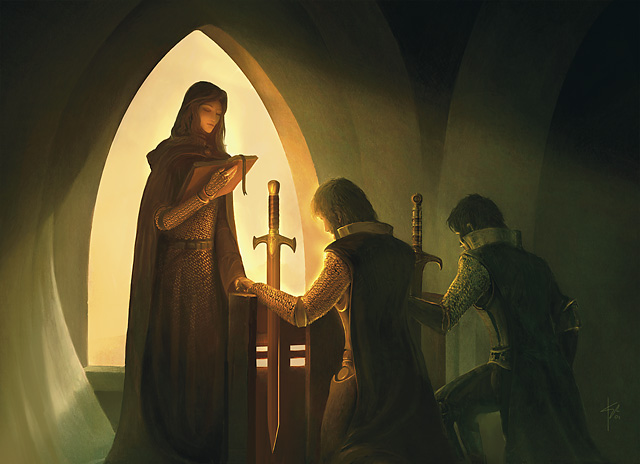
I would add the flowing modifications to the rule:
House Rule: The type of prayer that is needed to prepare a new list of cleric or paladin spells requires not only time (in minutes!, … ok fine), but it also must include a place, a time, or an activity, as required by the characters chosen deity, cleric domain, druid circle, or paladin oath. A cleric or paladin can regain spell slots for their all ready prepared spells alas normal, with a minimum of prayer.
The specific time place or activity is typically a temple or altar or holy place dedicated to the deity, domain, or oath. But if could also be something associated with the domain when an altar is lacking. The following are only examples of appropriate places, a times, or an activities that would allow certain types of cleric or paladin to change their spells. Players and DMs should come up with something appropriate for their game.
| Clerics Domain | Alternate places of spell preparation |
| Death (DMG) | At a place or recent murder, or historically significant murder. |
| Forge (XGE) | At any place of fire. |
| Grave (XGE) | At any grave site or place of final repose. |
| Knowledge | In any library, conservatory, or laboratory. |
| Life | At any place of clean water, still or flowing that can support life. |
| Light | Beneath the sun during specified time of day such as dawn. |
| Nature | In a natural place unmodified by man, or as per a druid circle. |
| Tempest | On a hill or mountain top, or any time during a storm. |
| Trickery | Before the altar or holy place of any god other than your won. |
| War | On a recent, or historically significant battle field. |
| Druid Circle | Alternate places of spell preparation |
| Dreams (XGE) | While sleeping. |
| Land | In the wilderness, on a high point, during the day time. |
| Moon | At night, in the wilderness, in full view of the moon. |
| Shepherd (XGE) | In the presence of a flock or heard of animals. |
| Paladins Oath | Alternate places of spell preparation |
| Conquest (XGE) | As per the Death, Knowledge, or War Domains. |
| Ancients | As per a related Druids Circe or the Nature Domain |
| Devotion | As per any appropriate Cleric Domain. |
| Redemption (XGE) | As per the Light or Life Domains. |
| Vengeance | As per the Tempest, Trickery, or War Domains |

 Jötunhiemr