Hello! I started this blog for one primary reason, as functional website and information hub for the games of Dungeons and Dragons (and other games) that I run for my friends. In addition, I may post some blog articles about D&D/gaming, we’ll see.
This blog exists as part of my gaming hobby and is strictly NOT FOR PROFIT. (and probably riddled with typos and spelling errors!)
You may notice that several pictures and images used in this blog (such as logos, banners, etc.) are, or have elements that are, “lifted” from published sources. I’m no lawyer but I think it all counts as “fair use” because I won’t be making any money from this blog. The list of sources or art includes published works be Wizards of the Coast and Kobold Press.
You may notice from the content in this blog that I am a fan of Kobold Press and their products. https://koboldpress.com/ I have no affiliation with the Kobolds. But I’ve enjoyed and recommend nearly everything that I’ve purchased from them and if you like cool D&D supplements you should check them out.
While it can be tempting (and freeing!) to dispense with restrictions of the use of magic and spell casting in D&D and similar RPGs. It definable makes bookkeeping much easier for players and DMs alike, but at what cost?
When we remove the need for material spell components pay a cost for the in-game convenience that we are seeking to acquire. That cost is the value of magic as something difficult and costly. In stories and literature what makes magic so compelling is not just the affects that a spell creates, but also the items needed and the times and places and actions required to enact the magical affect. Requirements are the stuff of magic.
What follows are individual rules or practices to help immerse a 5e D&D game with the idea that magic has costs. These home brews are intended to make as little change as possible to the rules as write in the 5e players handbook.
#1 Being strict with spell components.
Lets start by quoting what the PHB has to say on the matter.
Components A spell’s components are the physical requirements you must meet in order to cast it. Each spell’s description indicates whether it requires verbal (V), somatic (S), or material (M) components. If you can’t provide one or more of a spell’s components, you are unable to cast the spell.
Verbal (V) Most spells require the chanting of mystic words. The words themselves aren’t the source of the spell’s power; rather, the particular combination of sounds, with spe-cific pitch and resonance, sets the threads of magic in motion. Thus, a character who is gagged or in an area of silence, such as one created by the silence spell, can’t cast a spell with a verbal component.
Somatic (S) Spellcasting gestures might include a forceful gesticula-tion or an intricate set of gestures. If a spell requires a somatic component, the caster must have free use of at least one hand to perform these gestures.
Material (M) Casting some spells requires particular objects, specified in parentheses in the component entry. A character can use a component pouch or a spellcasting focus (found in chapter 5) in place of the components specified for a spell. But if a cost is indicated for a component, a char-acter must have that specific component before he or she can cast the spell. If a spell states that a material component is consumed by the spell, the caster must provide this component for each casting of the spell. A spellcaster must have a hand free to access these components—or to hold a spellcasting focus—but it can be the same hand that he or she uses to perform somatic components.
5e Players Handbook p. 203
Lets be honest. The purpose of all of these spell components is that they are things that can be taken away from the players. It’s right there, implied in the text.
Its classic stuff! Gandalf breaking Sauron’s staff or the Harkonnen thugs gagging Lady Jessica so she can’t speak. Its just that players hate it when it happens to them. But they should LOVE it, because it makes for great story, if done sparingly.
Whats interesting is how component pouch or a spellcasting focus are given in bold. Because who wants to track blades of grass and bits of cotton or metal wire, righht?
#1.1 Keep track of all your spell components.
This is easy. Its one page of paper with five coulombs. Spell Name; Verbal (Y/N); Somatic (Y/N); Material Component (MCs) & value; Number of MC’s on Hand
Once you’ve entered in a spell on this table the only thing you have to change is the last column, Number of MC’s on hand.
But now we run into the fact that keeping track of the mundane spell component (like blades of grass for magic missile) can feal pointless and annoying. This is exactly why the options for a component pouch or a spell casting focus exist.
#1.2 If you want to use a “component pouch” you need to spend downtime keeping it updated.
My preference is for players to keep track of actual components as described above. However if this is intolerable to the players or the DM then spellcasters who use a “comment pouch” need to spend time constantly updating and refreshing the components in their pouch.
This can be done as a downtime activity and can be customized to reflect the relative amount of spell casting done during an adventure. GM’s and players can determine exactly how much time this requires. If the character has cast a large number of spells they may not be able to use as much of their discretionary downtime as other characters. The DM is also free to rule that some components may not be acceptable in all places (blades of grass on the plane of fire for example).
#1.3 If you want to use a “spellcasting focus” you must bond with it.
For purposes of the following house rule “spellcasting focus” can refer to an arcane focus, a druid’s focus or a holly symbol. All three are treated the same.
House Rule: Before using it to cast spells, a spell caster must “bond” with their spellcasting focus. Bonding works similar to attunement except it does not use an attunement slot and the spell caster must bond with a focus up to the level for which they intend to use it. Bonding requires a Ritual Bonding Time and a Bonding Cost
Ritual Bonding Time: This is the time needed to bond with a spell casting focus. The step time is the time needed to increase ones bond with a focus in order to cast spells at a higher level. The total time is the time needed to bond with a newly acquired focus up to the desired casting level.
Bonding: This is gold piece value (gp) of the material components need for the bonding. If the item itself is particulary valuable or expensive then it can account for this cost itself. If the focus is humble origin and not very expensive then the balance of the bonding cost must be spent on items such as incense, gem dust, holly water, arcane oils, or blood. The step cost is the cost to upgrade a focus from one level to the next and the total cost is the cost needed to bond with a newly acquired focus up to the desired casting level. The following table are my sugested costs. They could be higher or lower or the DM could be more free-form in what it takes to craft/bond with a new focus. The pont is to not make it easy. Players need to somehow pay a cost for the convineince of using a spell casting focus.
Focus Bonding Level
Ritual Bonding Time (hours) Step Time , Total Time
Bonding Cost Step Cost, Total Cost
1
1 hour / 1 hour
25 gp / 25 gp
2
1 hour / 2 hours
50 gp / 75 gp
3
1 hour / 3 hours
75 gp / 150 gp
4
1 hour / 4 hours
150 gp / 300 gp
5
1 hour / 5 hours
225 gp / 525 gp
6
1 hour / 6 hours
325 gp / 850 gp
7
1 hour / 7 hours
450 gp / 1,300 gp
8
1 hour / 8 hours
700 gp / 2,000 gp
9
1 hour / 9 hours
1,000 gp / 3,000 gp
EXAMPLE: Your Wizards staff is broken! Time is short and the Orcs will be arriving in 3-4 hours. You can easy obtain a new staff but you lack the necessary arcane components for the bonding ritual. But in your adventures you obtained an amulet with a ruby easily worth 150gp. The orcs arrive early after 3 hours. In this example would have been able to bond with the amulet and use it to cast up to 3rd level magic.
#2 “Limiting” divine spell caster selection.
Divine spell casters (Clerics Druids, & Paladins) have one advantage over all other spell casters in the rules as written. They have access to their complete spell list and this spell list is always growing with each new supplement that is released. Most spell casters such as Bards, Warlocks and Sorceress only know a limited selection of their classes available spell lost. Wizards can potentially know a limitless number of spells but they must find and “learn” most of them, their by earning access to varied capabilities a key feature of their class. I find that in the current situation the cleric especially has so much versatility that they begin to step on the wizards toes. One way we can reminder this is by limiting limiting how and when a cleric can modify there prepared spells list.
The Players handbook states the following regarding how spells are prepared, the paladin operates in a similar way using charisma rather than wisdom.
You prepare the list of cleric spells that are available for you to cast, choosing from the cleric spell list. When you do so, choose a number of cleric spells equal to your Wis-dom modifier + your cleric level (minimum of one spell). The spells must be of a level for which you have spell slots. …
… You can change your list of prepared spells when you finish a long rest. Preparing a new list of cleric spells requires time spent in prayer and meditation: at least 1 minute per spell level for each spell on your list.
5e Players Handbook p. 58
I would add the flowing modifications to the rule:
House Rule: The type of prayer that is needed to prepare a new list of cleric or paladin spells requires not only time (in minutes!, … ok fine), but it also must include a place, a time, or an activity, as required by the characters chosen deity, cleric domain, druid circle, or paladin oath. A cleric or paladin can regain spell slots for their all ready prepared spells alas normal, with a minimum of prayer.
The specific time place or activity is typically a temple or altar or holy place dedicated to the deity, domain, or oath. But if could also be something associated with the domain when an altar is lacking. The following are only examples of appropriate places, a times, or an activities that would allow certain types of cleric or paladin to change their spells. Players and DMs should come up with something appropriate for their game.
Clerics Domain
Alternate places of spell preparation
Death (DMG)
At a place or recent murder, or historically significant murder.
Forge (XGE)
At any place of fire.
Grave (XGE)
At any grave site or place of final repose.
Knowledge
In any library, conservatory, or laboratory.
Life
At any place of clean water, still or flowing that can support life.
Light
Beneath the sun during specified time of day such as dawn.
Nature
In a natural place unmodified by man, or as per a druid circle.
Tempest
On a hill or mountain top, or any time during a storm.
Trickery
Before the altar or holy place of any god other than your won.
War
On a recent, or historically significant battle field.
Druid Circle
Alternate places of spell preparation
Dreams (XGE)
While sleeping.
Land
In the wilderness, on a high point, during the day time.
Moon
At night, in the wilderness, in full view of the moon.
Shepherd (XGE)
In the presence of a flock or heard of animals.
Paladins Oath
Alternate places of spell preparation
Conquest (XGE)
As per the Death, Knowledge, or War Domains.
Ancients
As per a related Druids Circe or the Nature Domain
I’m one of those Dungeon Masters who began playing D&D in the good old days of AD&D2nd Edition. Those of you who remember those youthful days will not be surprised when I say that … it kills me a little inside when my 5th edition players wake up after a long rest… fresh as a daisy sprite and at full Hit Points!
I have to work real hard to suppress the “old man” who wants to gripe,
“Back in my day you could only heal1 hit point per day of rest, or maybe3 for cushy “bed rest,” gosh darn it!”
Like a lot of DM’s I’ve tinkered with the ideas of “fixing” hit points and player damage. But I could never come up with a better set of home rules because the design isn’t broke and doesn’t need “fixing.”
Matt Colville, in his Running the Game #68, does a much beater job of explaining it than I ever could, when he says,
“Hit points work because that’s how we wished we worked…” they are“…a measure of your heroism…”
But… it still gals me that players will wake up the next day, after a punishing fight, with no ill affects whatsoever. It just feels so “wrong” that players should incur no lasting injuries as a result of taking high amounts of “damage” in “deadly encounters.”
One option would be to implement some of the alternative healing and resting rules that are on p.266-267 of the 5e Dungeon Masters Guide. But if those rules worked better than the rules in the Players Handbook I think they would not be alternate rules in the DMG. Also, allowing players to recover full HP in the morning fits very nicely with he whole “hit points are…a measure of your heroism…“ ideal.
So what we need is some way to give players an “injury” without messing with their hit points. By “injuriy,” I mean a home brew Injury condition. But unlike “wound levels” discussed by Colville, in the above linked video, I would only apply an “injury” when a player is reduced to zero (0) HP or fails a death saving throw.
Before you get any grand visions of rolling on multiple tables that cross-reference damage type/severity with body parts (believe me, that also my was my first instinct), remember that simplicity is a virtue and we already have an under used resource in the 5eD&D rule set that already looks a lot like injuries, … exhaustion.
THE “SIMPLE” INJURY CONDITION Whenever a player character is reduced to zero (0) or fewer HP, and whenever they fail a death saving throw, the character incurs a single level of the exhaustion condition as an injury.
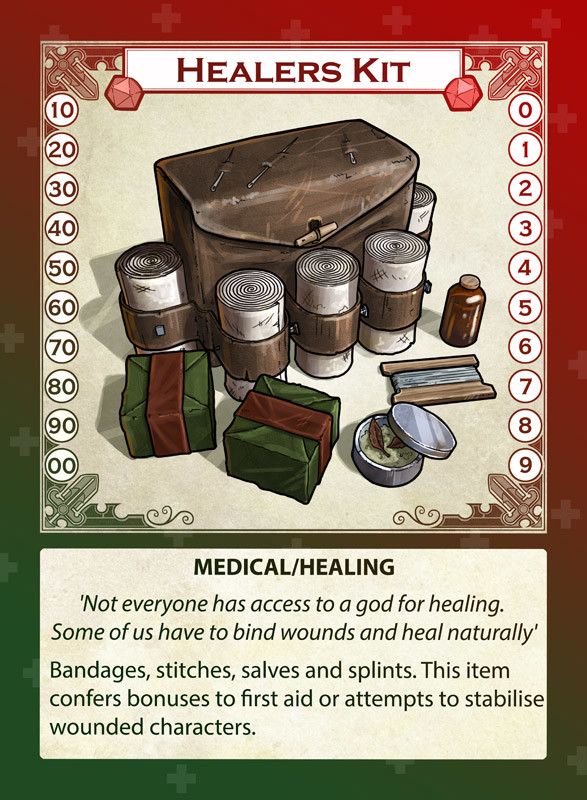
Like normal levels of exhaustion these levels of injury increase the characters over all exhaustion level. However, unlike normal levels of exhaustion, these “injury levels” can not be removed by simply completing a long rest. Levels of injury can only be removed by casting the Greater Restoration spell or with a successful DC20 medicine skill check. The medicine check can only be attempted once after the injured character has finished a long rest in which specific treatment for the injury was applied.
A successful healing check (or casting of the Greater Restoration spell) only removes a single level of the injury condition. Failed checks have no effect other than the injury condition persists and another check can not be made until after the injured character has completed another long rest.
I think this simple home brew option could have lots of fun consequences. Much like real injuries, full recovery from the injury condition can be highly variable in both its severity and the needed recovery time. As I indicated, and depending on how you play, the exhaustion condition could be a rather under used aspect of the 5e rule set. This home brew Injury condition makes exhaustion something that the players have to really think about. Adding this rule to your could potentially kill PCs who are already suffering levels of exhaustion, or who drop below zero hit pints multiple times during an adventure or encounter. The threat of lasting consequences due to an injury adds a real danger to a battles or encounters that might not otherwise be deadly enough to kill characters outright.
for use by DM’s with players who like to read everything
If you buy enough published roll-playing materials you’ll see something pop up again and again. Lots of adventures and setting/source books will have in-text “warnings” that say, things like, “this next section is for Game Masters only,” or “if your going to be a player in this adventure, don’t read any further.”
Arguably the later example, is the more important. Players shouldn’t read adventures that they want run for them. Or if they have read, or previously played through, an adventure that they are about to play in – those players should be up front with the person running the game about this and commit to working with he DM/GM to not ruining any of the adventure for the other players.
But unlike the example above, it can be less strait forward with how you deal with other “non-adventure” setting or source materials. Lots of “setting materials” are designated for both “Players” and “Dungeon Masters” in mind. This makes good sense for publishers who want to sell their books to as many people in the hobby as possible.
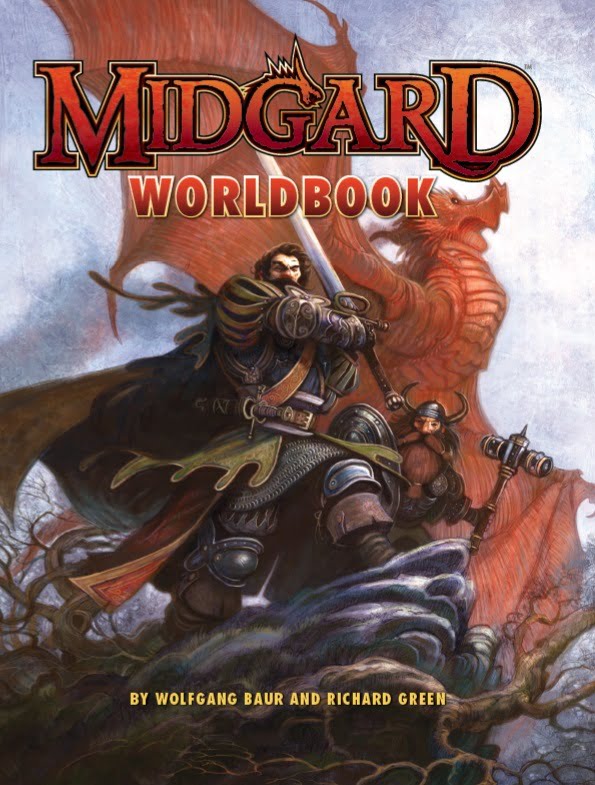
An excellent example of his is the “Midgard Worldbook,” by Kobold Press. It has things that are clearly the purview of both player and DM alike such as: cultural information of its various races and regions, information about its “gods,” an appendix containing its own 5e comparable features and spells for the game. It also has things we typical think as being the preview of only the DM such as: information about the “true alignments” and secret motivations of the various NPC characters; and, actual answers to some of the mysteries presented in the setting.
For Example: There is a large foot note section on page 293 the Midgard Worldbook, that explains the mystery of what has happened to The Imperatrix of Dornig (no spoilers here). To be honest, before I even saw that tid-bit of lore, I had already decided what had REALLY happened to the Imperatrix in my campaign, and it looked nothing like what your learn on page 293.
Note: You will be happy to know that my players did save and eventually did awake the Imperatrix from the “time-stasis” that her political rivals had thrust upon her, but not before she spent several weeks, in her time frozen state, and hidden within a coffin that was stored in the players bag of holding.
I didn’t (and would never) just hand the Worldbook to my players, saying something ridiculousness like “here is the setting document, read away!” No that’s to much especially for players who aren’t interested in that level of time investment. But occasionally you’ll get a player who just want’s to read EVERYTHING about the world. They may even want to read about those things that are outside the regions that your will be playing in. In such cases, I would argue that there is no reason to deny that player the thing that makes them happy. His enthusiasm is good for your game, so lend him the book, and let him read to his hearts content!
In my gaming group, I have one such player. After giving him access to my copy of The Worldbook he became better versed in the setting than I was!
This wasn’t a problem, but for one small issue. We all (no mater who we are) like to talk about the things that we like and share our knowledge on those subjects. Even if your player (like mine) doesn’t make a habit of regularly spilling the beans, information that you would prefer be kept secret can still come out at the table form time to time.
Game Masters have of course long had a solution to this issue – they change stuff!
This is nothing new, DM’s are constantly changing the contents of a local dungeon and “good” NPC’s always seem to have a habit of turning “EVIL” and betraying the players…
But this can create another (minor) problem. Although some of us like having our expectations subverted, especial in the context of a role-playing game, this is not true of everyone. Although your player(s) may not be intending to “abuse” their setting knowledge in the game, they still want to be able to “use” that knowledge.
That’s part of reason why they read the book! Again, they may not want to admit it, but players can find it very disappointing when you go and arbitrarily change the details of the world, that they invested so much time reading about.
This is ware my “Worldbook Rule” comes in. This is something that (ideally) you tell the player upfront, before handing them the source material.
The Worldbook Rule Everything in the Worldbook (or other setting documents) such as: NPC alignments and motivations; secret plots; answers to mysteries; and generally anything presented as “factual” or “true” – is actually a mater of public perception, local legends, conventional wisdom, or tavern gossip.
or more succinctly
Anything written in that book, may be true, false, or somewhere in between.
This may seem like an early and all to convenient cop-out, but it has interesting implications for your game. For one it makes all knowledge that can be read from a setting book actual “knowledge” that charters could be aware of.
Your players can “know” that a local ruler is “upstanding and just” or “a corrupt scoundrel”, because that is what most of the local populous actually says about them.
Applying this to my example, above: The thing said about the The Imperatrix of Dornig on page 293 of the World Book, becomes an actual thing that people are saying. It was complete bunk in my adventure (a convenient lie spread about to distract from the truth). But its still “information” that is out there and it doesn’t spoil anything for the player to have read it.
I should reiterate that the best time to make your players aware of “The Worldbook Rule” is before they have invested time reading the setting materials.
What the Wordbook Rule does, is it gives those players that want to “read it all” the freedom to do so. But now they know ahead of time that what they are reading may not be the actual truth but only what is commonly believed. In this context, the player can still make use of EVERYTHING that they have read in the course of the game.
While it might still be a little be unreasonable your players characters to have the kind of extensive knowledge about that world that is in the Worldbook or a different campaign setting – it is perfectly reasonable for them to have an idea about the things local to them that “everyone knows.”
The down side of curse is that this puts the onus on the DM to go about changing things that he or she might not other wise change as part of implementing the rule. But this is not necessary. There is nothing wrong with letting the players know things about the world and, more than likely, the DM was always planing to change or invent things to fit with key features and story elements of their planed adventures.
“Psihomodo Pop cover, Digitalno Nebo album,” by Milivoj Ćeran
A home-brew “Otherworldly Patron” Warlock Class option for Dungeons and Dragons, 5th edition. These options have not been play tested, and if you think they are “OP”, well good! A Jötun’s mighty arm should “over power” his enemies.
image from VOLO’S GUIDE to MONSTERS, by Wizards of the Coast
Some Jötuns are much more than simple giants, being more akin to lesser gods. Although usually prone to fits of wrath, they are very capable of appreciating wit, cunning, and magic every bit as much as brute strength. Jötun rarely make pacts with creatures so small as humans but if one impresses them enough they may do so. When this happens the Jötun grants power to the warlock with the expectation that on the day of Ragnarök the warlock will side with him in his battle against the Gods. Depending on the Jötun’s eagerness for hat fateful day he may also task the warlock with helping to bring it about.
Design Note: The expanded spell list granted by the Jötun focus on a enhancing the warlocks abilities (and potentially those of his companions) as well as allowing him greater control and interaction within surrounding environment. The “Otherworldly Abilities” granted by the Jötun are intended to increase the Warlocks fighting prowess in preparation for the day of Ragnarök.
THE PACT OF THE JÖTUN
Jötun Pact Expanded Spell List
The Jötun lets you choose from an expanded list of spells when you learn a warlock spell. The following spells are added to the warlock spell list for you.
Spell Level Spells 1st Fog Cloud, Thunderous Smite 2nd Enhance Ability, Enlarge/Reduce 3rd Meld into Stone, Protection from Energy 4th Freedom of Movement, Stoneskin 5th Commune with Nature, Destructive Wave
Otherworldly Abilities
THE JÖTUN’S CALL TO ARMS
At 1st level the warlock can speak, read, and write either Giant or Primordial (choosing between the two). The warlock also gains proficiency with both martial weapons and shields in addition to simple weapons and light armor. Finally, having prepared his mind for the day of Ragnarök the warlock loses all fear of death and gains immunity to the frightened condition.
BURST OF JÖTUN STRENGTH
At 6th level, after failing any strength ability check or strength saving throw the warlock may call on the Jötun’s power and re-roll the result with advantage and adding to the roll his charisma ability score modifier (in addition to his strength modifier). Once the warlock uses this feature, he must complete a short or long rest before using it again.
GIGANTIC EGO
Beginning at 10th level, as an action, the warlock may cast two spells at the same. Both spells must be concentration spells that target the warlock and only the warlock (for example: Enhance Ability, Enlarge/Reduce, or Protection from Energy). Only a single spell slot is expended for both spells. The spell slot used must be the at least the same level as the highest level of the two spells. If either or both of the spells allow, they may be cast at a higher level, up to the level of the spell slot used. If for any reason the warlock looses concentration then both spells end. If either spell reaches the end of its normal duration then both spells end. Once the warlock uses this feature, he must complete a short or long rest before using it again.
THE BONES OF AURGELMIR (or Ymir)
Starting at 14th level the warlock may take on the form of a giant for short periods of time.
As an action, the warlock picks up, swallows and consumes stones and earth from the ground. These materials must be available for him to use this ability. The warlock may not move, attack, cast spells, or take any other actions or reactions during the round in which he is consuming these earthen materials. This causes the warlocks body to grow until by the start of his next turn he has grown into a GIANT FORM with his height and other bodily dimensions all having increased to three and a half times his natural measurements and his weight being multiplied by fifteen.
The warlock must remain in GIANT FORM for a number of rounds equal to 1d4 plus his charisma ability modifier. The warlock may not return to normal size until this duration ends. Once the warlock uses this feature, he may not use it again until he has completed a long rest.
While in GIANT FORM the warlock has all the following characteristics:
GIANT FORM
The warlock’s size is Huge and he takes up a 15ft. x 15ft. square space in combat and his melee combat range is 10ft., or 20 ft. if using a reach weapon.
The warlock’s gear also increases proportionally to his new size. Dropped items return to their original size. While in GIANT FORM the standard bludgeoning, slashing and piecing damage for weapons roll three times the number of damage dice that they normally would. This increase to weapon damage does not apply to other forms of damage or to increased damage due to magical effects. (for example: a morningstar that typically rolls 1d8, will roll 3d8 when it is giant sized and a great sword that typically rolls 2d6 will roll 6d6 when it is giant sized, but acid damage from a vial of acid or magic fire, cold, necrotic, or other magic damage added to a weapon would not increase).
The warlock’s strength score increases by 10 points, resulting in an additional +5 bonus to your strength ability score modifier. Your dexterity score decreases by 4 points, resulting in a -2 penalty dexterity ability score modifier. The warlock’s speed is 40 ft.
The warlock is are completely immune to the affects of the Enlarge/Reduce Spell, even if he would be a willing recipient. In addition The warlock has advantage on all saving thaws against spells that would change his size and or shape; and,
The warlock gains he following Actions and Reactions:
ACTIONS Rock: Ranged Weapon Attack: utilizing strength, range 60/240 ft., one target. Hit: 4d10 + strength modifier, bludgeoning damage.
REACTIONS Rock Catching: If a rock or similar object is hurled at the giant, the giant can, with a successful DC 10 Dexterity saving throw, catch the missile and take no bludgeoning damage from it.









 Jötunhiemr